Valerie Murphy

Why Your Save File Becomes a Diary: Building the Perfect Cozy Gaming Rotation

The 2 AM Test: When Games Become Emotional Furniture

You’re scrolling through your Steam library at 2 AM, exhausted but not ready for sleep. Your cursor hovers over that AAA action game you bought last month, then drifts past it entirely. Instead, you click on Slime Rancher or A Short Hike. Something shifted in what you needed from games, and you probably didn’t even notice when it happened.

Cozy games work like emotional furniture in our digital spaces. They’re not designed to challenge your reflexes or pump adrenaline through your system. Instead, they create a sense of place where your brain can decompress. The best cozy titles understand that sometimes we need games to hold space for us, not demand performance from us.

Building a solid rotation of comfort games means recognizing which mechanics actually soothe your specific stress patterns. Some players need the meditative rhythm of farming simulators. Others find peace in exploration games with no fail states. The trick is identifying what “cozy” means to your nervous system, not just your aesthetic preferences.

The Goldilocks Zone of Engagement

Coffee Talk nailed something most developers miss about cozy gaming: the perfect balance between mental engagement and emotional safety. You’re learning customer preferences and mixing drinks, but there’s zero pressure to optimize or compete. Your mistakes just become part of the story, literally. This sweet spot between boredom and stress is where cozy games live.

Unpacking hits the same note. You’re solving spatial puzzles as you place belongings in new homes, but the game never judges your solutions. There’s no timer ticking down, no score to maximize. The engagement comes from the satisfaction of creating order and the gentle storytelling that emerges through objects. Each item carries narrative weight without requiring you to decode complex lore.

Look for games that give your hands something to do while your mind processes the day. Spiritfarer’s crafting system keeps your fingers busy with resource gathering and building, but the emotional core centers on caring for spirits before helping them move on. The mechanical loop supports the emotional experience instead of overwhelming it.

Building Your Comfort Game Emergency Kit

Every cozy gamer needs what I call an emergency kit: five games that work when everything else feels too much. Start with different engagement levels. Keep one completely passive experience like Proteus or Flower for when decision-making feels impossible. Add something with gentle progression like Garden Story where you can make small, visible improvements to the world.

Include at least one game with satisfying, repetitive mechanics. PowerWash Simulator sounds ridiculous until you experience the zen of watching grime disappear under your virtual pressure washer. The progression is clear, the results are immediately visible, and there’s something deeply satisfying about restoring objects to their clean state. It scratches the same itch as organizing your desk or folding laundry, but without the real-world effort.

Don’t sleep on older handheld games for cozy sessions. Harvest Moon: Friends of Mineral Town on Game Boy Advance has this wonderfully contained feeling that modern farming sims sometimes lack. The pixel art creates distance from photorealism, making the virtual world feel more like a safe dollhouse than a simulation. Plus, Tsuyoshi Tanaka’s soundtrack perfectly captures that golden-hour nostalgia that makes handheld gaming feel extra cozy.

The Sound of Safety: Why Audio Design Matters

Animal Crossing gets talked about constantly, but people underestimate how much the audio design contributes to its comfort factor. Those gentle plinking sounds when you shake trees or dig holes aren’t just feedback, they’re audio comfort food. The game’s soundscape never includes harsh frequencies or sudden loud noises. Even the hourly music changes gradually, maintaining the peaceful atmosphere across different times of day.

Gris demonstrates how audio can carry emotional weight without being overwhelming. The watercolor visuals get most of the attention, but Berlinist’s adaptive soundtrack responds to your actions in subtle ways. The music swells and recedes based on your movement, creating a responsive environment that feels alive without being demanding. It’s like having a conversation with the game through sound.

Pay attention to games with strong ambient audio tracks. Firewatch might seem too narrative-heavy for cozy gaming, but the forest sounds create an incredibly immersive sense of place. Sometimes just wandering the woods while Henry and Delilah chat over the radio provides exactly the kind of gentle human connection that makes a game feel cozy, even when the story deals with heavier themes.

Creating Your Own Cozy Gaming Rituals

The hardware matters more than you might think. Playing Stardew Valley on a Steam Deck while curled up in bed hits different than the same game on a desktop setup. The physical comfort of handheld gaming enhances the emotional comfort of cozy titles. If you’re primarily a PC gamer, consider how your setup affects your relationship with these games. Sometimes the most powerful gaming rig isn’t the right tool for the job.

Build rituals around your cozy gaming sessions. I keep a specific playlist of lo-fi hip hop for games that benefit from external music, like when I’m doing repetitive tasks in Minecraft. The combination of familiar audio comfort and gentle game mechanics creates a deeper sense of relaxation than either element alone. Tea, specific lighting, even particular times of day can all contribute to making your gaming space feel more intentionally cozy.

Consider keeping a gaming journal for your cozy sessions. Not for optimization or completion tracking, but to notice patterns in what you need from games during different emotional states. You might discover that rainy days call for different comfort games than stressful work periods. Understanding your own patterns helps you build a more intentional relationship with gaming as self-care.

What games have become your emotional furniture? What mechanics help your mind settle when everything else feels chaotic?
When $2 Billion Marketing Budgets Became Normal: GTA VI and the Death of Gaming as We Knew It

Remember When Games Just Had to Be Good?

I’ve been thinking a lot about GTA: Vice City lately. You know that feeling when “Billie Jean” kicks in while you’re cruising down Ocean Drive at sunset? Pure magic, right? The whole game cost around $9 million to make, and somehow it captured something that felt infinite. Fast forward to 2026, and Take-Two Interactive just dropped the news that they’re spending two billion dollars just to tell people GTA VI exists. Not to make it. Just to market it.

When $2 Billion Marketing Budgets Became Normal: GTA VI and the Death of Gaming as We Knew It

Let that sink in for a moment. According to Take-Two Interactive investor relations, this marketing budget is the largest promotional investment in entertainment history. That’s more than some countries spend on their entire annual defense budgets. It’s enough money to fund hundreds of indie studios for years. But here we are, watching the industry chase numbers that would make Hollywood blush.

I’m not saying GTA VI won’t be incredible. Early glimpses suggest Rockstar has made something genuinely impressive. But when the conversation shifts from “will this be fun” to “will this justify a marketing spend larger than NASA’s annual budget,” something fundamental has shifted in gaming culture. We’re not just buying games anymore. We’re investing in entertainment ecosystems that demand our wallets, our hard drives, and apparently our souls.

The Pre-Order Phenomenon That Broke Records

Within 72 hours of GTA VI’s announcement, 23.4 million people had already committed their money. That’s $1.6 billion in guaranteed revenue before anyone has even played the thing. Those numbers are staggering, but they also tell a story about how disconnected we’ve become from the actual experience of discovering games organically.

I remember when pre-ordering meant walking into GameStop and putting five bucks down on something that looked cool in a magazine. There was risk involved, sure, but it was manageable risk. Now we’ve got pricing tiers that stretch from $90 to nearly $300, with promises of “10 years of guaranteed content updates” that sound more like subscription agreements than game purchases. The Premium Edition asks players to mortgage a decade of their gaming future on a single title.

The psychology here fascinates me. We’re so hungry for genuine gaming experiences that we’ll throw money at the promise of one, even when that promise comes wrapped in corporate speak about “ongoing content ecosystems” and “persistent engagement frameworks.” It’s like we’ve forgotten that the best games were often the ones we stumbled across by accident, not the ones that demanded our attention through billion-dollar marketing campaigns.

When 180GB Isn’t Enough

Here’s where things get really interesting from a technical perspective. GTA VI clocks in at 180 gigabytes, but that’s just the starting point. For the first time in AAA gaming history, a major release is abandoning the concept of local-only storage entirely. Mandatory cloud streaming components mean parts of the game simply won’t exist on your hardware.

On one hand, this makes sense. Modern open-world games are incredibly complex, and cloud technology allows for experiences that would be impossible on local hardware alone. Dynamic weather systems, real-time economic simulations, AI-driven narratives that adapt to millions of players at once. These are genuinely exciting technological possibilities.

But I can’t help thinking about my friend who still plays San Andreas on his modded Xbox because his internet is spotty. Or the countless players in regions where reliable broadband isn’t guaranteed. We’re trading ownership for access, permanence for innovation. Maybe that’s progress, but it’s also the end of gaming as a medium you can truly own. When the servers shut down in 15 years, what happens to those billions of dollars in pre-orders?

The Studio Expansion That Nobody Talks About

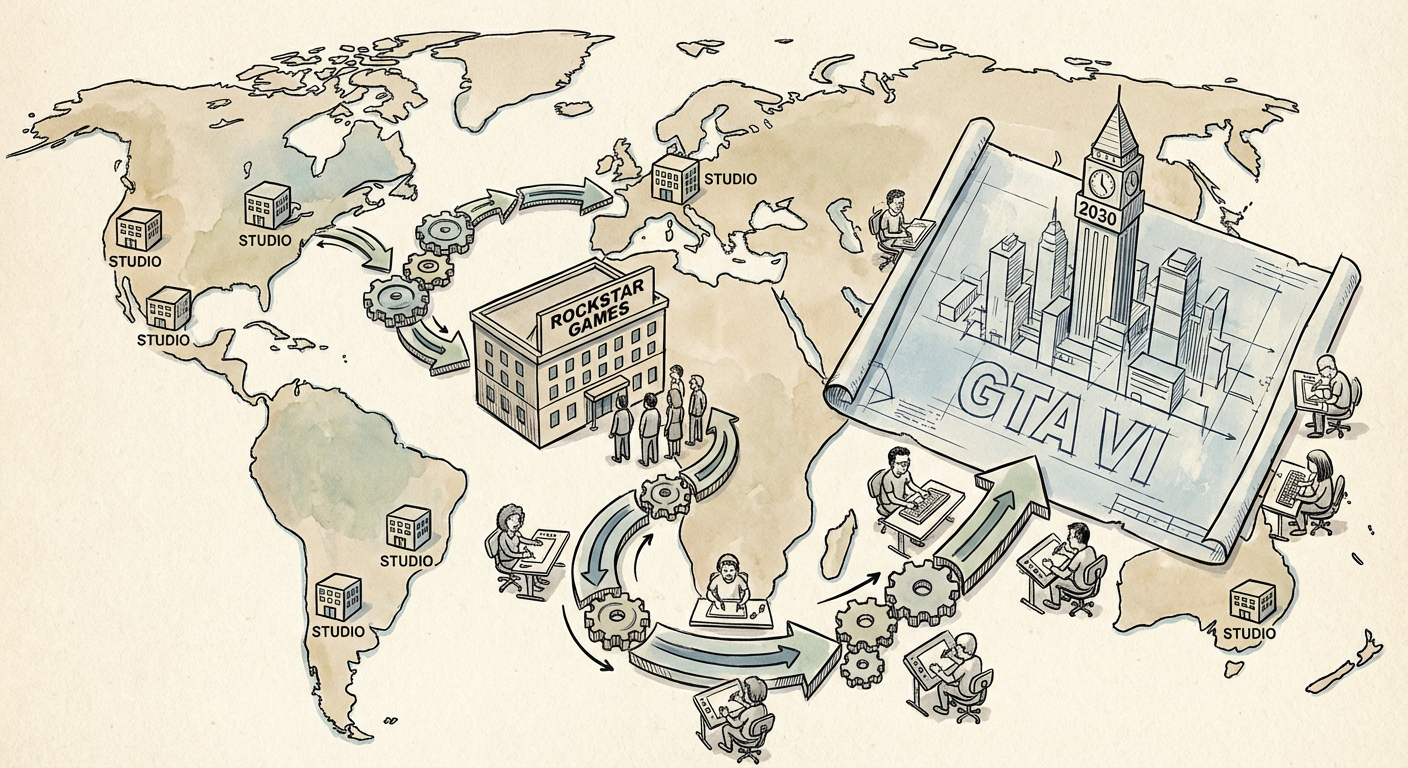
Behind all these numbers is perhaps the most telling detail: Rockstar hired 340 additional developers across eight studios specifically for GTA VI’s post-launch content development through 2030. According to the Rockstar Games development blog, this is the largest workforce expansion in the company’s history.

This isn’t just about making a game anymore. It’s about building a platform that will consume development resources for the better part of a decade. These 340 people aren’t working on GTA VII or the next Red Dead. They’re committed to feeding the content machine that GTA VI will become. That’s exciting for players who want their favorite game to evolve continuously, but it’s also a massive bet that a single game can sustain interest for nearly half a decade.

I think about smaller studios like Supergiant Games, who created Hades with a team of about 20 people. That game delivered more genuine innovation and emotional impact than most AAA releases from the past five years. Now we’re in an era where 340 developers is considered a reasonable allocation for post-launch support alone. The scale is impressive, but I worry we’re optimizing for engagement metrics rather than the kind of breakthrough experiences that make people fall in love with gaming in the first place.

What We Gain and What We Lose

Don’t get me wrong. I’m genuinely excited to see what Rockstar does with this level of investment and ambition. The technical achievements will probably be stunning. The world they’re building will likely set new standards for interactive entertainment. And honestly, after years of half-finished releases and broken promises, there’s something refreshing about a company putting their money where their mouth is.

But I can’t shake the feeling that we’re watching the end of an era. When marketing budgets hit two billion dollars, when pre-orders generate more revenue than most games ever see, when storage requirements demand cloud integration, we’re not just talking about bigger games. We’re talking about a fundamentally different relationship between players and the medium we love.

The games that shaped me weren’t the ones with the biggest budgets or the most aggressive marketing campaigns. They were the weird experimental titles, the unexpected sequels, the passion projects that somehow found their audience through word of mouth and genuine enthusiasm. I worry that in our rush toward these massive, all-consuming entertainment platforms, we’re leaving less room for those happy accidents that make gaming magical.

What do you think? Are we witnessing the evolution of gaming into something better, or are we trading the soul of the medium for spectacle? I’d love to hear your thoughts on where this all leads, especially if you’ve got stories about games that surprised you in ways no marketing budget could have predicted.

When Fan Passion Fixes What Publishers Forgot: Three Mods That Saved Their Games

The Sound of Silence That Wasn’t Supposed to Be

Picture this: you boot up Silent Hill 2 on your modern gaming rig, eager to revisit James Sunderland’s psychological nightmare. The fog rolls in, the radio crackles, but something feels wrong. The audio compression sounds like it was fed through a potato masher, and the character models look like they wandered in from a completely different decade. This isn’t nostalgia playing tricks on you. The HD Collection really was that broken.

Enter the Enhanced Edition mod by a dedicated team who spent three years fixing what Konami couldn’t be bothered to. They restored the original fog effects, fixed over 400 audio files, and even brought back the proper lighting that made those hallway encounters genuinely terrifying. Sometimes the most passionate preservationists aren’t the ones getting paid to do it.

Teaching Old Dogs New Tricks: The OpenMW Tutorial

Morrowind sits in this weird space where everyone knows it’s brilliant, but actually playing it in 2024 requires either serious patience or serious modding. The OpenMW project doesn’t just slap new textures on an old engine. It rebuilds Morrowind from the ground up, fixing decades-old bugs while keeping that distinct Bethesda jank that somehow makes everything charming.

Getting OpenMW running takes about twenty minutes and feels like performing surgery on your childhood memories. You download the engine, point it toward your existing Morrowind installation, then watch as loading times that used to stretch into coffee break territory shrink to mere seconds. The best part? Your old save files work perfectly. Those random crashes that taught you to quicksave every thirty seconds become ancient history.

The real magic happens when you start layering in graphics mods. Morrowind Graphics Extender gives you dynamic shadows and better water reflections. Tamriel Rebuilt expands the mainland with content that feels more authentic than half the official DLC from other franchises. Within an hour, you’re exploring a version of Morrowind that looks better than you remember but feels exactly like it should.

The Soundfont Revolution That Nobody Talks About

Here’s something that’ll make you question everything: most of your favorite retro game soundtracks probably sound wrong. Not bad, just different from what the composers actually intended. Take Final Fantasy VI’s opera scene, arguably one of the most emotionally powerful moments in gaming history. On original hardware, it sounds majestic but limited by the Super Nintendo’s audio capabilities.

The MSU-1 audio mod scene has quietly revolutionized how we experience these classics. Dedicated musicians have re-recorded entire soundtracks using real orchestras, then programmed them to sync perfectly with the original games. Zelda: A Link to the Past with full orchestral audio hits different when you’re wandering through the Dark World. The emotional weight that was always there in the composition finally gets the presentation it deserves.

Installing these mods requires patience and very specific ROM setups, but the payoff transforms familiar experiences into something that feels both nostalgic and completely fresh. It’s like discovering that your favorite childhood book had entire chapters you’d never read.

When Fans Become Feature Directors

Project M might be the most successful example of a community completely reimagining a beloved game. Super Smash Bros. Melee had this incredible competitive depth that felt accidental, while Brawl felt deliberately designed to remove that complexity. The Project M team looked at this situation and basically said, “What if we made Melee 2 ourselves?”

They rebuilt Brawl’s engine to include Melee’s movement options, rebalanced the entire roster to tournament viability, and added quality-of-life improvements that even modern Smash games lack. Characters who were bottom-tier jokes in Brawl suddenly became tournament threats. The mod scene around Project M developed its own meta, its own tournaments, and its own legendary moments that rival anything from official competitions.

What makes Project M special isn’t just the technical achievement. It represents this perfect storm where passionate fans had both the skills and dedication to improve upon something they loved, rather than just complaining about it. The mod died for legal reasons, but its influence shaped how we think about competitive Smash Bros. for the next decade.

The Preservation Problem Nobody Wants to Discuss

Corporate game preservation ranges from inconsistent to actively hostile. Companies either ignore their back catalogs entirely or release bare-minimum ports that somehow run worse than fan-created alternatives. Meanwhile, small teams of volunteers work nights and weekends to ensure these experiences survive in forms that actually respect the original vision.

The AM2R saga perfectly illustrates this tension. A single developer spent eight years creating a Metroid II remake that felt more authentically Metroid than anything Nintendo had released in years. Nintendo killed the project immediately, then released their own Metroid II remake that was fine but lacked the obvious love and attention to detail that made AM2R special. The fan project understood what made the original work on a level that seemed to escape the actual rights holders.

This pattern repeats constantly across gaming. Fan translations of games that were never localized. Bug fixes for broken releases. Accessibility options that should have been included from day one. The mod community consistently shows more care for gaming history than the industry itself.

These passion projects raise uncomfortable questions about who really owns our gaming heritage and who’s actually protecting it. Next time you fire up that perfectly preserved classic game, take a moment to wonder: who made this possible, and what did they have to risk to do it?

Why That One Banjo-Kazooie Track Still Makes You Cry (And Other Secrets of Game Music That Actually Matters)

The Sound That Hooked You Before You Even Knew It

You’re eight years old, controller in hand, and suddenly that melody from Bubblegloop Swamp starts playing. Twenty years later, you hear those first few notes and you’re instantly transported back to summer afternoons and the smell of your mom’s cooking drifting in from the kitchen. That’s not nostalgia working alone. That’s Grant Kirkhope understanding exactly how melody, harmony, and emotional memory create something bigger than background music.

Game soundtracks don’t just go with our experiences. They get wired into our brains. The best composers know this and write every measure with that in mind. But here’s what most people miss: the technical choices that make certain tracks stick with you forever while others just blend into pleasant background noise.

Why Chiptunes Hit Harder Than Your Spotify Playlist

The Game Boy Advance had four audio channels and composers like Michiru Yamane somehow made Castlevania: Aria of Sorrow sound like a full orchestra was trapped inside that tiny speaker. Those hardware limits didn’t hold back creativity. They sharpened it. When you can only use four sounds at once, every note has to fight for its spot.

Take Tim Follin’s work on Silver Surfer for the NES. He turned the system’s pulse wave channels into aggressive lead guitars and used the noise channel for percussion that actually grooves. The result sounds nothing like typical 8-bit music because Follin refused to accept what everyone said those chips could do. Modern producers spend thousands on vintage hardware trying to get back that focused intensity.

Today’s unlimited track counts often lead to crowded mixes where nothing stands out. Those old limits taught composers to make every element count. There’s a reason why Mega Man 2’s “Dr. Wily Stage 1” still goes harder than most modern game music.

The Indie Scene Is Quietly Revolutionizing Game Audio

While AAA studios chase cinematic orchestral scores, independent developers are creating some of the most creative game music in decades. Disasterpeace’s work on Hyper Light Drifter proves you don’t need a 90-piece orchestra to hit you in the feelings. Those crystalline synthesizer arpeggios and carefully placed silences create more tension than any bombastic action movie score.

FEZ deserves special mention for how its soundtrack actually connects with gameplay mechanics. When you rotate the world, the music shifts perspective too. Layers fade in and out based on your viewing angle. It’s not just background music anymore. It’s part of the puzzle itself.

These smaller teams often give composers more creative freedom than major publishers. The result is music that takes risks and explores sounds you’ll never hear in a focus-tested blockbuster. Dead Cells, Celeste, and Hollow Knight all have soundtracks that would never survive a corporate boardroom but perfectly match their games’ personalities.

Technical Craft Behind Those Goosebump Moments

Great game music works because composers understand interactive audio in ways that film and TV composers don’t have to think about. Jesper Kyd’s work on the original Assassin’s Creed shows this perfectly. The main theme builds and pulls back based on what you’re doing, creating musical punctuation for moments of discovery and tension without ever getting repetitive.

Loop design is an art form that gets zero respect outside gaming circles. A track needs to cycle for potentially hours while staying interesting and emotionally relevant. Listen to how Gusty Garden Galaxy from Super Mario Galaxy handles this challenge. The melody feels complete in each loop but gains new layers of meaning as you explore the level and hear different instrument combinations.

Dynamic mixing takes this concept further. Modern games can layer multiple versions of the same track and blend between them based on what’s happening in the game. Nier: Automata’s vocal layers that fade in during emotional story moments represent smart programming working with solid composition. The technology works for the artistic vision instead of just showing off.

Finding Your Gateway Into Game Music Appreciation

Start with what you already know you love, then trace those influences backward and forward. If you’re obsessed with that one track from your favorite game, find out who wrote it and explore their other work. Koji Kondo didn’t just create the Super Mario Bros. theme. His approach to melody influenced an entire generation of composers.

Don’t ignore cover versions and arrangements. The amount of care that fans put into recreating and reinterpreting game music reveals layers you might miss in the original chiptune versions. Guitar covers of Mega Man themes, jazz arrangements of Zelda songs, and orchestral versions of Final Fantasy tracks all highlight different aspects of the original compositions.

Try playing some of these games with headphones if you haven’t already. Game audio often gets lost through TV speakers or laptop audio. A decent pair of headphones reveals spatial audio design, subtle layering, and frequency ranges that completely change how the music feels. That bass drop in the Metroid Prime save room theme hits completely different when you can actually hear the sub-bass frequencies.

What game soundtrack moment still gives you chills every time? Think about why that specific combination of music and gameplay created something memorable enough to stick with you years later.

Why Your Fingers Know More About Game Design Than You Think

The Language Your Hands Already Speak

I was halfway through Celeste’s Chapter 7 when I realized something strange. My left pinky had developed muscle memory for the dash-grab combo that I’d never consciously practiced. The Keychron K8’s tactile switches were giving me feedback I didn’t know I needed. Each keypress felt deliberate, purposeful. It wasn’t just about the game anymore—my keyboard had become part of the design language.

This is the hidden conversation happening between your peripherals and the games you love. Every mechanical switch, every controller curve, every button placement is making design decisions alongside the developers. Your hardware isn’t just an input device. It’s a collaborator in the experience, shaping how you interpret timing, rhythm, and intention in ways that most reviews completely miss.

When Switches Tell Stories

The Akko Cream Yellow switches in my daily driver have a 50g actuation force and a subtle bump right at the activation point. Playing Hollow Knight with these feels like the keyboard is whispering secrets about the game’s pacing. Each spell cast has weight. Each nail swing feels considered. Compare that to the linear Gateron Reds I used before, they’re smooth as silk, perfect for rapid-fire inputs, but they turn every action into a whisper when some games need you to shout.

I tested this theory with A Hat in Time’s more forgiving platforming. The Reds made Hat Kid’s movements feel floaty and dreamlike, matching the game’s whimsical tone perfectly. But when I switched to Kailh Box Navy switches, clicky, heavy, almost aggressive, suddenly every jump felt like a commitment. The same game, but the tactile feedback was rewriting the emotional language of each leap.

This isn’t about expensive equals better. It’s about matching the conversation your fingers are having with the conversation the game wants to have. The $60 RK61 with Gateron Browns gave me more meaningful feedback in Inscryption than a $200 board with switches that fought against the game’s deliberate, card-playing rhythm.

Controllers That Think Like Designers

The 8BitDo SN30 Pro+ looks like nostalgic window dressing, but its D-pad reveals something profound about game design philosophy. The slightly mushy, interconnected feel isn’t a compromise, it’s a love letter to the era when developers designed around hardware limitations and turned those constraints into features. Playing Shovel Knight with this controller versus a modern Xbox gamepad is like watching the same film in its original aspect ratio versus a remastered crop.

I spent three weeks with the PowerA Fusion Pro 3 trying to understand why its triggers felt wrong for racing games but perfect for Dark Souls. The answer was in the resistance curve. The triggers have this gradual buildup that matches the deliberate timing of souls-like combat, where every attack is a conversation between planning and execution. But in Forza, where smooth acceleration curves matter, that same resistance felt like the controller was second-guessing my driving.

The Razer Wolverine V2 Chroma taught me something else entirely. Its hair-trigger locks seem like a competitive feature, but they completely change how stealth games feel. In Dishonored 2, the shortened trigger travel made every crossbow shot feel precise and intentional, like Corvo’s expertise was flowing through the hardware into my hands.

The Frequency of Feeling

Haptic feedback is where hardware becomes poetry. The DualSense controller’s adaptive triggers in Deathloop aren’t just mimicking gun recoil, they’re teaching your fingers about weapon personality. The shotgun’s heavy, satisfying resistance tells a story about power and consequence that no visual effect could match. Each weapon type speaks a different language through your index finger.

But it’s the subtle stuff that reveals the real craft. In Ghost of Tsushima, the controller’s gentle rumble when Jin’s feet touch different terrain types isn’t just immersion, it’s environmental storytelling through touch. Grass feels different from stone because the game wants you to understand Jin’s connection to the natural world versus the rigid structures of honor and tradition.

Even older tech has wisdom to offer. The original Xbox controller’s asymmetrical stick placement feels awkward until you play something like Steel Battalion or MechAssault. Suddenly that chunky design makes sense, it was built for games about piloting massive machines, where comfort mattered less than the feeling of operating something substantial and complex.

Finding Your Hardware Voice

The real magic happens when you stop thinking about specs and start thinking about conversations. My friend swears by his Anne Pro 2 with lubed Gateron Yellows for rhythm games, not because they’re the fastest switches, but because their smooth linear action matches how he thinks about musical timing. The tactile bump of a Brown switch would interrupt his flow, turning Beat Saber into a stuttering conversation instead of a smooth dialogue.

I keep three different controllers within reach because different games speak different dialects. The precision of a mechanical keyboard for pixel-perfect platformers. The analog subtlety of the Xbox Elite Series 2 for games that live in the spaces between binary inputs. The chunky, deliberate feel of the 8BitDo M30 for anything that remembers when six buttons felt like plenty.

This isn’t about having the “best” gear. It’s about understanding that every piece of hardware is making design choices alongside you. When you find the right match between your tools and your games, something beautiful happens, the boundary between intention and execution disappears, and you’re not fighting your keyboard or wrestling with your controller. You’re having a conversation, and for once, everyone involved is speaking the same language.

What conversations are your fingers having with your favorite games? And more importantly, are you listening to what they’re trying to tell you?

The Couch Multiplayer Renaissance: Why We’re Living in the Golden Age of Local Party Games

When “Pass the Controller” Actually Meant Something

Picture this: it’s 2003, and you’re huddled around a CRT television with three friends, taking turns on Tony Hawk’s Pro Skater because you only have one controller. The person playing has exactly two minutes to nail that impossible combo before everyone starts getting restless. Those were simpler times, right? Well, not exactly.

The Couch Multiplayer Renaissance: Why We're Living in the Golden Age of Local Party Games
The Couch Multiplayer Renaissance: Why We’re Living in the Golden Age of Local Party Games

I’ve been thinking about this a lot lately, especially after rediscovering some absolute gems in my collection and realizing how much our nostalgia can cloud the actual experience. Sure, we remember the laughter and the bonding, but we tend to forget the frustration of waiting forever for your turn, or how many “multiplayer” games were just glorified turn-taking exercises. The truth is, we’re living in an absolute golden age of local multiplayer gaming right now, and it’s time we gave credit where credit is due.

Today’s couch co-op scene isn’t just better than what we had fifteen years ago, it’s completely different. Developers have figured out how to make games that are actually inclusive, immediately accessible, and endlessly replayable. The barrier to entry has never been lower, and the ceiling for fun has never been higher.

The Unsung Heroes Making Magic Happen

Let me introduce you to some developers who are absolutely crushing it in ways that would make your GameCube weep with joy. Take Team17’s Moving Out, which sounds like the most mundane concept imaginable until you’re accidentally throwing your friend’s character out a second-story window while trying to navigate a couch through a kitchen. The genius isn’t in the premise, it’s in how the game turns chaos into cooperation and makes failure feel like the best part.

Then there’s Gang Beasts from Bonelobo, a game that looks like it was designed by someone who watched too many Jello wrestling matches and thought “what if we made this into a fighting game?” The controls are intentionally awkward, the physics are gloriously unpredictable, and somehow this creates the most level playing field I’ve ever experienced in a competitive game. Your friend who’s been gaming since the Atari 2600 has the same chance of accidentally falling off a platform as someone who picked up a controller for the first time five minutes ago.

But here’s where it gets really interesting: these aren’t big budget productions from major studios. Most of the best party games today come from small teams who understand something that escaped the industry for decades. Fun doesn’t scale with polygon count or marketing budget. It scales with creativity and understanding what makes people laugh together.

Breaking Down the Barriers We Didn’t Know We Built

I used to think Super Smash Bros. Melee was the pinnacle of accessible fighting games. Then I tried teaching it to newcomers and watched them get combo’d into oblivion while I explained the seventeen different ways to recover from being launched. Nostalgia had convinced me that button mashing was enough to have fun, but the reality is that Melee’s skill gap creates a pretty miserable experience for casual players.

Compare that to something like ARMS on the Switch, which maintains incredible depth while letting anyone throw a punch and feel powerful from minute one. Or look at how Overcooked strips cooking down to its most frantic, communication-heavy elements without requiring anyone to memorize combo inputs or frame data. These games succeed because they prioritize the group experience over individual mastery.

The real revelation for me came when I watched my partner’s parents, who haven’t touched a video game since Pac-Man, absolutely demolish a round of Fall Guys. They were strategizing, trash-talking, and having genuine competitive moments. That’s when I realized how much of what I considered “timeless” about older multiplayer games was just familiarity bias. We adapted to clunky interfaces and unfair mechanics because we didn’t know better options existed.

The New Classics You’re Probably Sleeping On

Let’s talk about some games that deserve spots in your regular rotation. Boomerang Fu might look like a simple top-down brawler, but its boomerang-catching mechanics create these incredible moments of skill expression that feel earned rather than gate-kept. Everyone can throw a boomerang, but timing that perfect catch-and-redirect takes practice that feels rewarding rather than frustrating.

Unrailed! is another masterpiece that disguises intense cooperation as a cute train-building game. You’re working together to lay tracks, gather resources, and keep your train moving, but the real game is in the communication. It’s like Overcooked but with more long-term planning and fewer kitchen fires. The satisfaction of pulling off a perfectly coordinated resource run with three friends is unmatched.

And if you want something that captures the pure joy of discovery, try Heave Ho. It’s a physics-based climbing game where everyone controls a pair of arms, and you have to work together to swing across gaps and reach the goal. The learning curve is immediate and hilarious. You’ll spend the first ten minutes accidentally dropping each other, but by the end of the session, you’ll be pulling off coordinated maneuvers that feel like magic.

Why This Moment Matters More Than We Realize

Here’s what gets me most excited about the current state of local multiplayer: we’re finally seeing games designed specifically for mixed-skill groups. Developers are thinking about the friend who only plays mobile games, the parent who wants to connect with their kids, and the hardcore gamer who just wants to turn their brain off and laugh. This inclusivity isn’t just nice, it’s completely changed what’s possible.

The Switch deserves enormous credit for making this possible. Having four controllers built into the system removes one of the biggest barriers to spontaneous multiplayer sessions. But the real magic is happening in the game design itself. Studios are learning that the best party games aren’t about showing off technical prowess, they’re about creating shared experiences that everyone can contribute to meaningfully.

What really strikes me is how many of these games handle failure. In older multiplayer games, losing often meant sitting out or feeling left behind. Modern party games turn failure into entertainment. Getting eliminated in Fall Guys means you get to watch and cheer. Messing up in Moving Out creates a story everyone will remember. This shift in perspective has completely transformed what multiplayer gaming can be.

I’d love to hear about your own discoveries in the local multiplayer space. What games have surprised you with their staying power? Have you found any hidden gems that deserve more attention? Drop your recommendations in the comments, especially if you’ve got stories about introducing gaming to skeptical friends or family. The best part about this whole thing is that there’s room for everyone at the table.