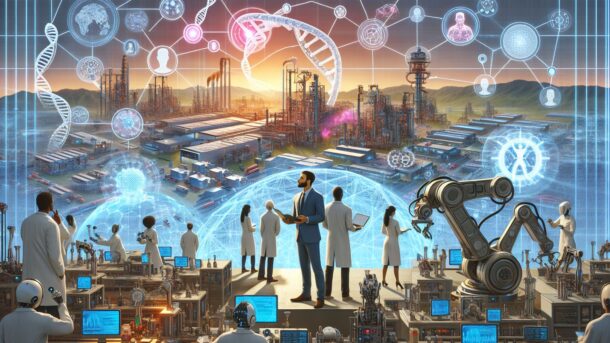
Hey, tech enthusiasts! Have you felt it? That buzzing energy that seems to get stronger each day? If so, you’re not alone. We’re not just standing at the edge of change, we’re diving headfirst into the Fourth Industrial Revolution, and honestly, some of these breakthroughs are pretty wild. This isn’t just about cooler gadgets or faster processors. It’s about a complete transformation that’s changing every part of human life. So grab your favorite beverage and let’s dive into this tech revolution that’s happening right now.
What Exactly Is the Fourth Industrial Revolution?
Before we get into the specific breakthroughs making headlines, let’s set the stage. The Fourth Industrial Revolution (4IR) is more than just a buzzword. It’s defined by technology that blurs the lines between the physical, digital, and biological worlds, and it’s changing how we live, work, and interact with each other. While previous revolutions brought us mechanization, mass production, and computerized automation, this one goes much further. It’s driven by artificial intelligence, robotics, quantum computing, nanotechnology, biotechnology, the Internet of Things (IoT), and a whole lot more.
The implications? They’re pretty staggering. We’re not talking about small tweaks to existing systems but rather a complete paradigm shift. Think renewable cities, job markets completely reinvented by automation, and diseases stopped in their tracks by biotechnology. The canvas is huge, and we’re painting with an entirely new set of tools.
Breaking Down the Breakthroughs: Tech That’s Erasing Boundaries
The AI Renaissance
First stop on our tour is Artificial Intelligence, which is basically the backbone of the 4IR. From improving healthcare through predictive diagnosis to creating symphonies with machine learning, AI is clearly leading this technological transformation. Companies are building AI-driven models that analyze data with speed and accuracy we’ve never seen before, detecting patterns and insights that would be completely invisible to humans.
But it’s not just about raw processing power. AI personal assistants are becoming part of our daily routines, customizing everything from the boring stuff to the amazing. They schedule our meetings, curate our content, and even provide companionship. Which honestly raises some interesting philosophical questions about our relationships with machines.
AI ethics has also become a major conversation. How do we make sure AI develops in ways that align with human values? As these systems grow more powerful, the question isn’t just what AI can do, but what it should do.
Blockchain Beyond Cryptocurrency
Blockchain’s potential is another major revelation of the 4IR, and it goes way beyond Bitcoin and other cryptocurrencies. Its decentralized and secure nature could revolutionize data integrity, traceability, and transparency. Supply chains are becoming completely transparent, contracts are getting smarter, and data breaches might become a thing of the past.
The rise of Decentralized Autonomous Organizations (DAOs) is also transforming how companies operate. Picture an organization run on blockchain code, without traditional hierarchical structures, where voting power is spread among stakeholders. Pretty exciting, right? Blockchain artists are pushing boundaries too, using NFTs to transform digital ownership and giving creators new ways to make money from their work.
The Age of Longevity
This one might blow your mind. The longevity field isn’t just about living longer, it’s about filling those extra years with health and vitality. Advances in biotechnology, regenerative medicine, and age-reversal science are pointing toward something completely new. Researchers are working around the clock to figure out cellular decay and chronic diseases, trying to extend not just how long we live but how well we live.
Organ cryopreservation, gene therapy, and personalized medicine aren’t science fiction anymore. Well-funded tech startups and biotech companies are racing toward breakthroughs that could make reaching 100 years old much more common, which would fundamentally change everything from healthcare systems to retirement planning.
Robotics: From Fiction to Reality
When I talk about robotics today, I’m not talking about those clunky old automatons. I’m talking about sophisticated devices that can operate on their own, learning and adapting to their environment in real time. Robots are moving into areas we thought would be impossible, from delicate surgical procedures to space exploration.
Warehouse logistics has become a showcase for this technology, with Amazon and others using robots to sort, package, and ship goods with incredible precision and efficiency. In hospitals, robots perform precise tasks under a surgeon’s guidance. And industrial robotics? They’re reaching new heights in manufacturing, cutting down on human error and speeding up production times.
Nanoelectronics: Working with the Invisible
The nanoelectronics field is fascinating because it connects the incredibly small with the incredibly powerful. As transistors get close to atomic scales, researchers are exploring new materials like graphene to maximize efficiency. At this tiny scale, quantum properties become important, pushing us away from traditional silicon-based approaches into the uncharted territory of quantum computing.
Quantum supremacy is still the holy grail, and researchers are working hard to reduce quantum error rates and increase qubit coherence. The possibility of solving previously impossible problems in seconds is tantalizing for everything from cryptography to weather prediction.
What This All Means: Wrapping Up the Possibilities
It definitely feels like the world is moving at hyperspeed, with technology changing course and charting new paths almost daily. The Fourth Industrial Revolution, with all its breakthroughs, is creating something that connects the possible with what we once thought was impossible. But like every revolution, it’s not just about the technology, it’s about the people who create it, use it, and live with it.
Sure, the road ahead looks pretty chaotic with disruptions everywhere, but if we use these technologies wisely, they could help solve some of our biggest challenges, from environmental problems to social inequality. It’s more than an industrial shift. It’s a cultural renaissance with technology at its center.
So where do you fit into all this? Whether you’re a developer at a tech startup, someone who’s just curious, or someone directly working on these breakthroughs, remember this: The Fourth Industrial Revolution is bigger than just industry. It’s about expanding what’s possible and redefining human potential.
And honestly, we’re just getting started. Get ready for what’s coming next because it’s going to be incredible! What do you think will have the biggest impact? I’d love to hear your thoughts and predictions. Let’s talk tech in the comments below!
Stay curious, stay informed. Until the next breakthrough! 🌐
Disclaimer: As with any technological forecast, outcomes are speculative and subject to myriad influencing factors.