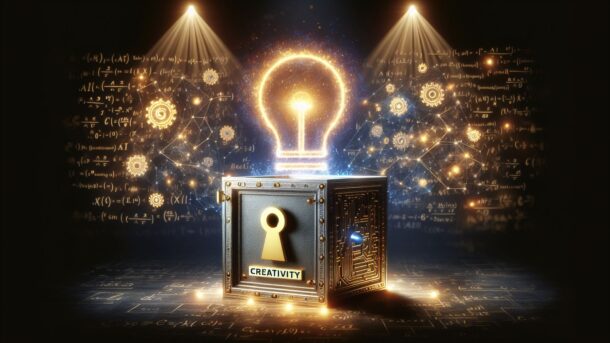
Hello, amazing readers! Today, I’m buzzing about a topic that’s not just tickling my technophile fancy but is also changing the world of creative arts—Artificial Intelligence (AI). It’s not just about robots flipping burgers or algorithms predicting the stock market anymore. AI has sashayed into the arts, and it’s causing quite the stir! So, grab a cup of coffee (or tea, I won’t judge), get comfy, and let’s dive into the wonderful world of AI in creative arts.
The Brave New World of Artistic AI
Picture this: you’re standing in front of a surrealist painting at a gallery opening, the artist is absent because it’s an algorithm. We’ve come a long way from when AI was just executing commands. Now, it’s creating masterpieces, composing symphonies, and penning poetry that can make your heart skip a beat.
I remember when I first encountered an AI-generated artwork. It was a piece created using a neural network trained on the styles of famous painters. The result? An original work that could easily hang in the Louvre. It was like seeing an old friend with a new haircut, familiar yet intriguingly different. That’s what AI is doing. It’s taking something known and adding its own twist.
How Does It All Work?
Ah, the million-dollar question! At the heart of these artistic endeavors is something called Generative Adversarial Networks (GANs). Think of GANs as two AI systems in a constant dance-off. One tries to create something new, while the other critiques it. Back and forth they go, until what emerges is something that even the harshest human critics might find impressive.
GANs are behind many of the AI artworks we see today. They’ve been trained on countless images, styles, and techniques, absorbing them like a sponge, only to wring them out into something unique and striking. And AI doesn’t stop there! It’s venturing into music, film, and literature, challenging our traditional notions of creativity itself.
A Symphony of Algorithms
Not too long ago, I attended a concert where half of the pieces were composed by AI. If you’d closed your eyes, you wouldn’t have been able to tell which compositions were human and which were algorithmically generated. From complex classical pieces to catchy pop tunes, AI is changing what it means to create music.
Companies like OpenAI with their model MuseNet, and Google’s Magenta are leading the charge. They’re doing more than just spitting out notes. These systems learn from human musicians, understanding structure, style, and emotion to create pieces that resonate on a deeply human level.
What Does This Mean for Musicians?
This is where the conversation gets juicy. Some musicians view AI as a collaborator, an endless well of inspiration and a new tool in their creative toolbox. Others see it as competition. But let’s be honest here, it’s a bit like fearing the synthesizer when it was first introduced. It didn’t replace musicians. It enhanced what they could do.
I’m all for embracing AI as a creative partner. Imagine an open jam session where your band includes a neural network! The possibilities are as limitless as the code that runs them.
From Pen to Pixels
Literature, too, has entered the AI arena. GPT-3, from OpenAI, is like that kid in class who seems to know everything. Capable of producing text that’s eerily human-like, it can draft articles, write fan fiction, even finish lines of poetry.
Let me tell you about the first time I dared to let GPT-3 help write a short story. I sat there, both awed and slightly terrified at how it picked up on the subtle cues and themes I wanted to explore. Sure, it needed a little editorial polish. What writer doesn’t? But the bones of something remarkable were there.
The Future of Storytelling
Storytelling is evolving, and AI might just be its next chapter. Collaborative works between humans and AI are popping up, leading to hybrid stories that push the boundaries of narrative and prose. It’s like co-writing with an imaginative friend who never runs out of ideas.
Challenges and Considerations
Before we start throwing AI art exhibitions and signing albums, we need to consider some challenges and ethical questions. Who owns the rights to AI-created art? How do we ensure that AI creations don’t inadvertently perpetuate biases present in its training data? And most critically, how do we continue valuing human creativity?
Ownership and Ethics
Ownership is a sticky wicket. Does the programmer own the art, or does it belong to the AI? Or perhaps to society as a whole? These are questions without clear answers yet, but they’re important as this field continues to evolve.
Let’s also talk about ethics. AI art is fantastic, but it’s still shaped by the dataset it’s trained on. If there are biases in that data, they can manifest in unexpected ways. It’s like baking. Your cake will only be as good as the ingredients you use.
Imagining Tomorrow
As we ponder the future, I maintain a techno-utopian optimism about AI’s role in creative arts. AI isn’t here to replace artists. It’s here to amplify what we can do, break down creative barriers, and venture into uncharted territories of expression.
Just imagine: art exhibitions that adapt based on audience feedback in real-time, symphonies that compose themselves in response to the day’s news, novels co-authored by humans and algorithms that explore new dimensions of storytelling. The creative possibilities with AI are as expansive as the universe itself.
So here’s to the brave new world of artistic AI, the painters, composers, and poets of the digital age. I, for one, can’t wait to see what they come up with next! Cheers to a future painted with pixels, sung by symphonies of silicon, and written in lines of code.